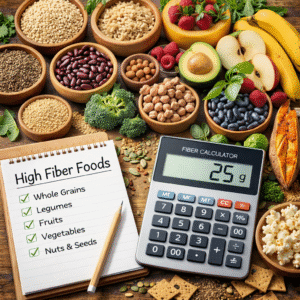
High Fiber Foods for Health: How to Boost Your Fiber Intake with Dietary Guidance and a Fiber Calculator
Fiber is an essential nutrient that plays a crucial role in maintaining digestive health, regulating blood sugar levels, and supporting

The Cholesterol Ratio Calculator is a vital cardiovascular health tool that analyzes the relationship between your total cholesterol and HDL (good) cholesterol levels. This essential calculation provides deeper insight into heart disease risk than individual cholesterol numbers alone, helping you and your healthcare provider make informed decisions about cardiovascular health management.
Our cholesterol ratio calculator performs two critical calculations to assess your heart health comprehensively. First, it divides your total cholesterol by HDL cholesterol, creating your primary ratio. Second, it calculates your LDL/HDL ratio for additional risk assessment. Simply input your latest lipid panel results—total cholesterol, HDL, and LDL values—and receive instant risk evaluation.
The optimal cholesterol ratio falls below 3.5:1, though ratios up to 5:1 are considered acceptable. Higher ratios indicate increased cardiovascular risk, signaling the need for lifestyle modifications or medical intervention. This calculation matters because it reveals how effectively your good cholesterol protects against bad cholesterol buildup in arteries.
Using the cholesterol ratio calculator regularly helps track your cardiovascular health progress over time. Whether you’re managing existing conditions or preventing future problems, understanding your ratio empowers proactive health decisions. The results guide dietary adjustments, exercise planning, and medication discussions with your physician.
Your cholesterol ratio responds positively to healthy lifestyle changes. Regular monitoring demonstrates how increased physical activity, Mediterranean-style eating, and stress reduction improve your cardiovascular profile. Many users find tracking their improving ratios motivating, transforming abstract health goals into measurable achievements.
An ideal cholesterol ratio is below 3.5:1, while anything under 5:1 is considered acceptable, with lower ratios indicating better cardiovascular health protection.
Divide your total cholesterol by your HDL cholesterol level; for example, 200 total cholesterol divided by 50 HDL equals a ratio of 4:1.
The total cholesterol to HDL ratio is most commonly used, though the LDL to HDL ratio provides valuable additional insight into cardiovascular risk.
Cholesterol ratios are strong predictors of cardiovascular disease risk, often more accurate than individual cholesterol values for assessing overall heart health.
Increase HDL through regular exercise, omega-3 fatty acids, and weight management while lowering total cholesterol with dietary changes and, if needed, medication.

Fiber is an essential nutrient that plays a crucial role in maintaining digestive health, regulating blood sugar levels, and supporting

Aging is a natural part of life, but how we age is influenced by various lifestyle choices. While we can’t

Pregnancy due dates feel like a magical milestone during the journey to parenthood. You enter a date, hit calculate, and

How to Calculate BMI and Body Age for Fitness When it comes to fitness, knowing your body mass index (BMI)

Calculating Body Mass Index (BMI) becomes more complicated after limb loss. Standard BMI calculators do not account for missing limb

Understanding your healthy cholesterol ratio is crucial for heart health. In fact, many people focus solely on total cholesterol, but